Your percentages change as prices change
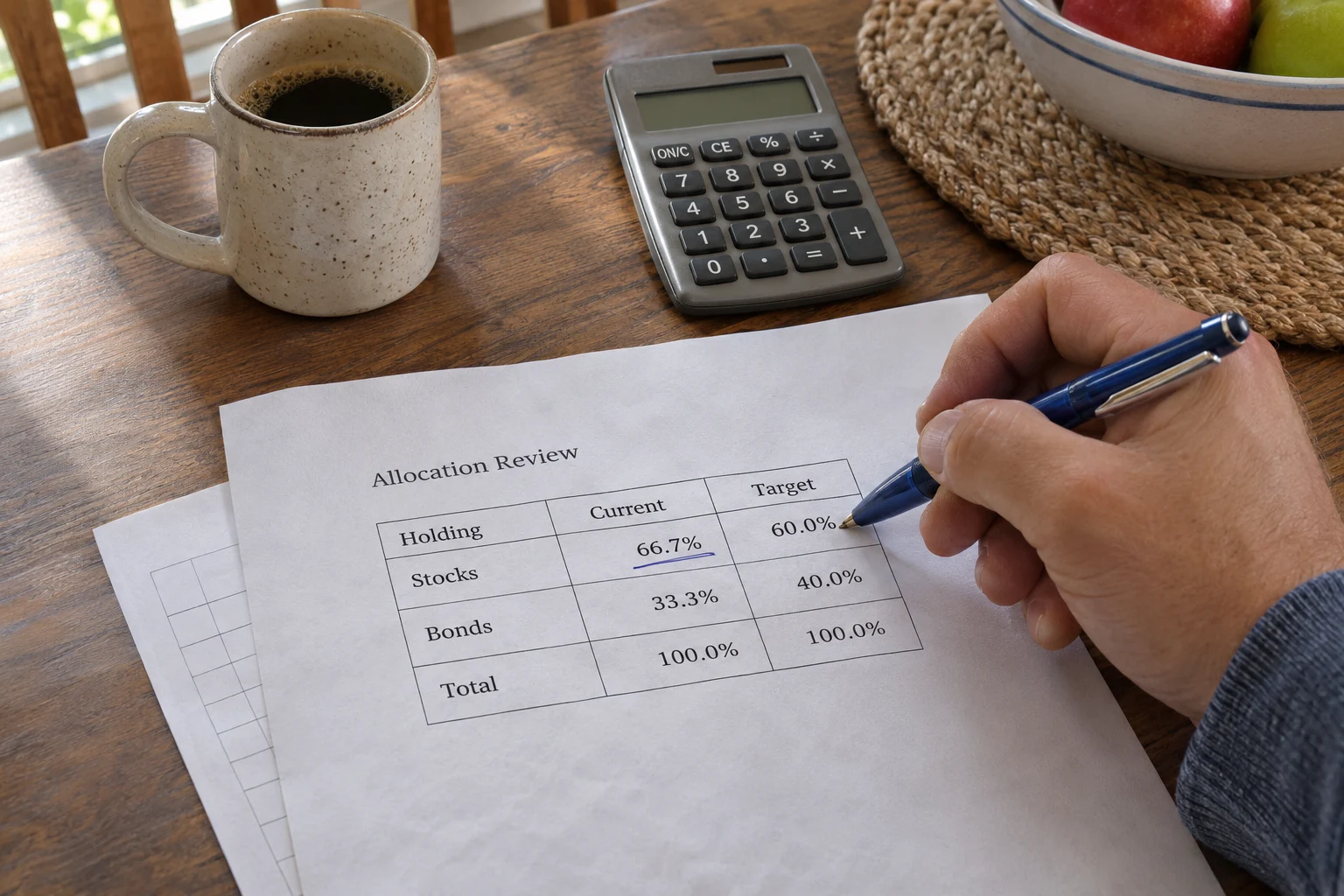
Your 60/40 mix becomes 66.7/33.3
Imagine $6,000 in stocks and $4,000 in bonds. Stocks rise to $8,000 while bonds stay at $4,000. You now have $12,000 total, with two-thirds in stocks. Nothing was added, but your account now leans more heavily on stocks.
Rebalancing adjusts holdings to bring the percentages back toward a target. Changing the target is a separate decision, made when your goals or circumstances change. You do not have to treat every small movement as a reason to trade.
A complete dollar example
For the $12,000 account above, a 60% stock target equals $7,200. A 40% bond target equals $4,800. Ignoring costs and taxes, selling $800 of stocks and buying $800 of bonds would restore the mix.
Rebalancing does not create extra money at the moment you do it. It changes which investments hold the money.
You can sometimes use new contributions instead of selling. In this example, adding $1,333.33 to bonds would make the $8,000 stock holding approximately 60% of the new total. That assumes you have the extra cash and ignores trading constraints.
Before
After
A real market example: 2008 into 2009
Now use actual annual returns with an imaginary $100,000 starting account. In 2008, stocks fell and Treasuries rose. The stock share shrank from 60% to about 44.2%. The bars below show percentages, not the amount of money in the whole account.
Resetting to 60/40 meant selling some Treasuries and buying stocks after a bad stock year. That can feel uncomfortable. It illustrates why a written rule can matter more than how a particular week feels.
Stocks rose and Treasuries fell in 2009 in this dataset, so resetting helped over this particular sequence. It will not always improve returns; in a sustained trend, leaving the mix alone may do better.
Resetting the mix, not creating extra money
How to read it: The full width always means 100% of the account. The dollar total beneath it can change.
What it means for you: After the market moved, buying stocks and selling Treasuries restored the chosen mix. This example ignores taxes and costs.
Go deeper: numbers, assumptions, and source
| Stage | Stocks | Treasuries | Total |
|---|---|---|---|
| Start of 2008 | 60.00% | 40.00% | $100,000 |
| End of 2008 | 44.21% | 55.79% | $86,110 |
| After reset | 60.00% | 40.00% | $86,110 |
NYU Stern / Damodaran, 2000–2025, nominal U.S. dollars. Hypothetical mixes reset annually, reinvest returns, and exclude fees, taxes, and cash flows. Not fund performance.
Pick a review habit you can actually keep
One approach is to review at a set time, such as a yearly check-in. Another is to review after a holding drifts beyond a preselected range. These are examples of methods, not a universal best schedule.
Percentage points are different from percent
If a stock target is 60%, a five-percentage-point band above it ends at 65%. A 5% increase relative to the target ends at 63%. Write the rule clearly so you do not have to interpret it in a stressful market.
Before selling, check trading costs, spreads, redemption restrictions, and possible taxes. Account rules differ. A small adjustment that creates a large bill may deserve a closer look.
The five-minute check-in
- Has life changed?
Revisit the goal before restoring a target that no longer fits.
- What is the mix today?
Look across relevant accounts. Two accounts may hold the same risks.
- Is action needed?
Compare with the rule you chose. Consider whether new contributions can help.
- Keep a short note.
Record what you changed and why. That gives your next review a useful starting point.
The point is to manage the risks you agreed to take—not to identify the next winner.
Questions readers ask next
A few practical questions related to this guide. Browse all 36 questions →
Sources & editorial notes
- Investor.gov: asset allocation and diversification
- CFPB: building an emergency fund
- FDIC: what deposit insurance covers
- Investor.gov: index funds
- NYU Stern / Damodaran historical U.S. returns
- BLS annual-average CPI-U
Historical sources were checked Nov 4, 2026; beginner education sources Nov 5, 2026. All people and personal-money examples are fictional. Charts distinguish historical data from hypothetical calculations.
AI-assisted educational content, not yet reviewed by a licensed financial professional. This is general information, not a personalized investment recommendation. Investment losses are possible. Product, account, and tax rules should be checked for your circumstances.